
Service · AI / ML
Models that shipto production
End-to-end AI / ML — from problem framing and data prep to trained models, APIs, and monitoring that keep predictions useful.
Capabilities
AI / ML for decisions that need a model
Forecasting, vision, ranking, and custom models — designed to reach production with clear metrics and ownership, not a notebook demo.
Predictive analytics
Forecast demand, churn, and risk with models tuned to your data.
Computer vision
Detect defects, classify images, and extract signals from visual feeds.
Custom models
Train and evaluate models for classification, ranking, and NLP tasks.
MLOps & APIs
Deploy inference endpoints with monitoring so models stay useful in prod.
Lifecycle
From problem to monitored model
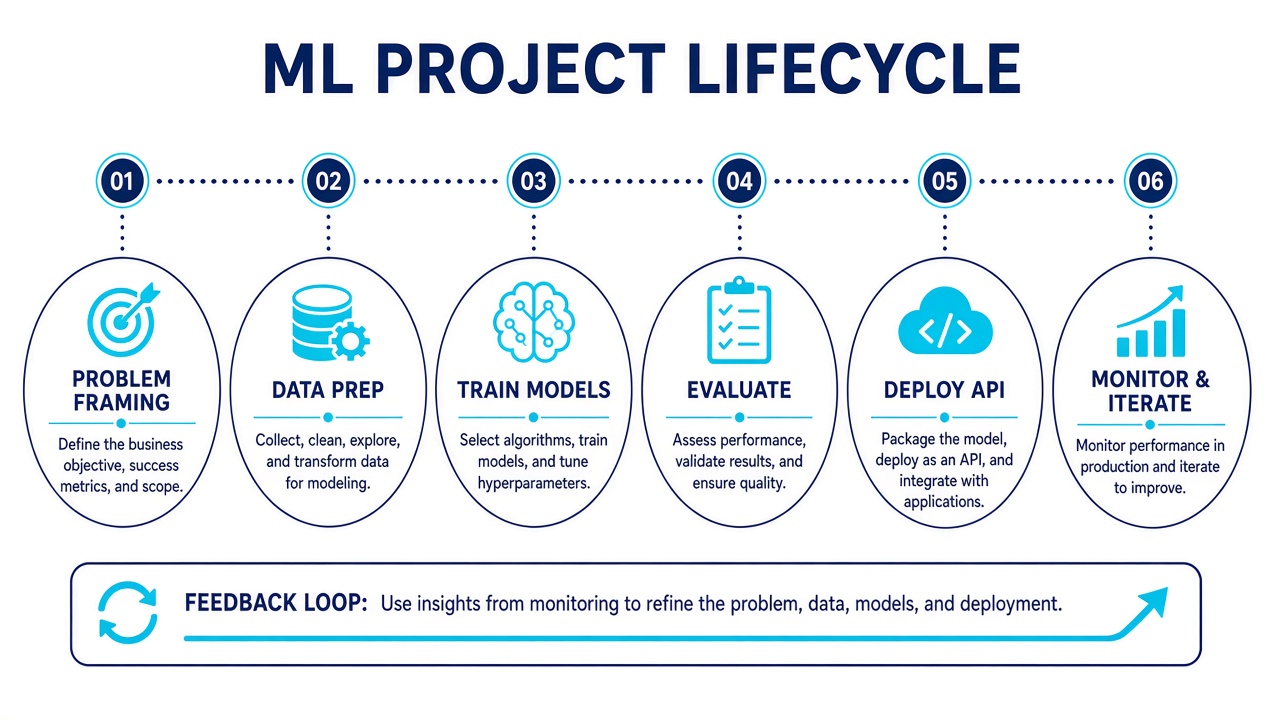
Same lifecycle every engagement — so scope, data, and production readiness stay honest from framing through retrain.
- 01
Problem framing
Define the decision, success metric, and data you already have.
- 02
Data prep
Clean, label, and split data — with leakage checks before training starts.
- 03
Train models
Baselines first, then stronger candidates — tracked in a model registry.
- 04
Evaluate
Holdout metrics, error analysis, and business-threshold checks — not demo accuracy.
- 05
Deploy API
Inference service your apps can call, with versioning and rollback.
- 06
Monitor & iterate
Drift, latency, and quality signals feed the next training cycle.
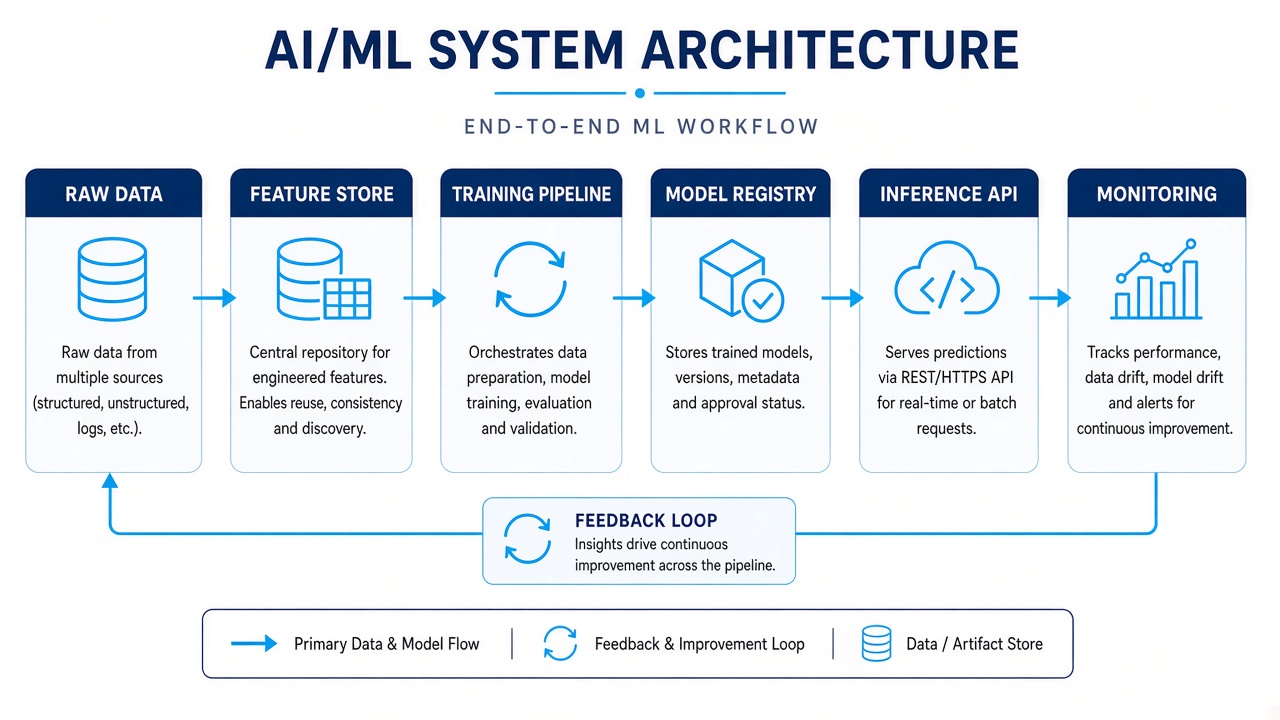
Pipeline
How the ML system connects
Data in, features out, models trained and registered, then served behind an API with monitoring that catches drift early.
Raw data
Warehouses, logs, files, and event streams that feed the project.
Feature store
Reusable features so training and inference stay consistent.
Training pipeline
Reproducible jobs for prep, train, and eval with logged artifacts.
Model registry
Versions, metadata, and approval before anything goes live.
Inference API
Low-latency predictions your products and automations can call.
Monitoring
Drift, errors, and cost — so production models do not silently decay.
Examples
Where a model earns its place
Production-ready delivery — honest evaluation, iterative ownership, and a secure data path.
Churn & demand
Score who will leave or what to stock — before the week gets expensive.
Visual QA
Flag defects or classify product images on the line or in intake.
Ranking & NLP
Search relevance, ticket routing, or document classification at scale.
Live inference
Versioned APIs your product calls, with drift alerts when data shifts.

Stack
Built for training, serving, and iteration
Tools & stack
What we build AI / ML with
Practical data, training, serving, and MLOps — so models stay maintainable after launch.
Data
SQL / warehouses · Feature prep · Labeling flows
Training
PyTorch / sklearn · Experiment tracking · Eval suites
Serving
REST / gRPC APIs · Batch jobs · Versioned models
MLOps
CI for models · Registry · Rollback
Monitoring
Drift alerts · Latency · Quality samples
Vision / NLP
CV pipelines · Embeddings · Classification
- Problem brief and success metrics before training
- Evaluated model with known failure modes
- Inference API + monitoring handover for your team